알아서 (Al-a-seo): Why the Korean Who Orders for the Whole Table Is Actually the Most Thoughtful Person There
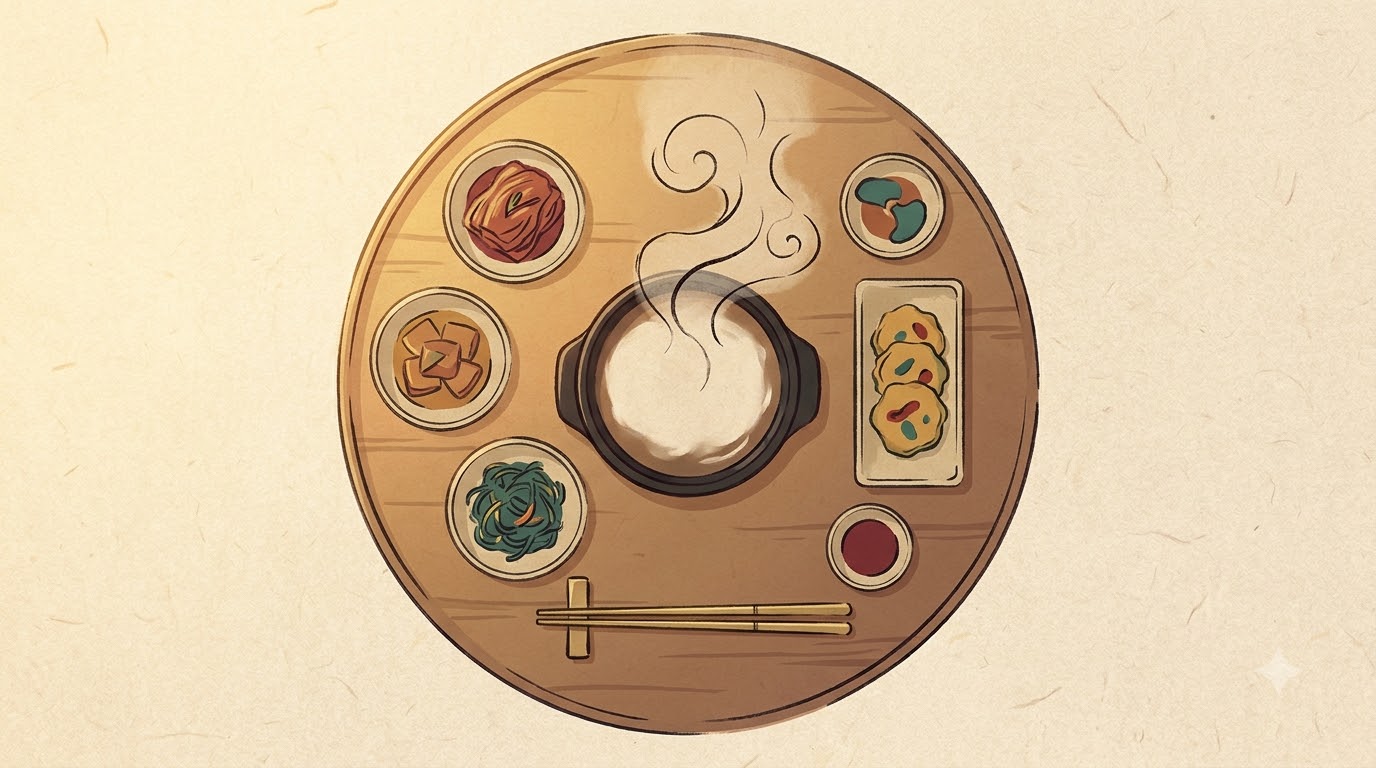
The menus haven't even been opened yet. A senior colleague glances at the server, lifts two fingers slightly, and begins to speak. Four portions of the house galbi, a doenjang jjigae to share, extra sangchu wraps, a specific drink to cut the richness — the whole order delivered in maybe thirty seconds. Then he sets the laminated menu down and rejoins the conversation as if nothing happened.
For an international visitor sitting across that table, the moment can feel disorienting. Did anyone ask me what I wanted? The instinct, shaped by cultures that treat personal menu choice as a small but meaningful form of self-expression, is to read this as someone steamrolling the group.
That reading is almost always wrong.
The Thing That Looks Like Control
A common scene goes like this: four colleagues at a crowded Seoul galbi restaurant, the kind where the charcoal smoke hangs low and the tables are close enough that you can hear the next party laughing. Before the youngest person at the table has finished unfolding her menu, the most senior member has already caught the server's eye and placed the entire order — for everyone.
Many international visitors and expats describe the same first reaction: mild alarm. The instinct is to reach for the menu, to rehearse dietary preferences, to wonder whether there will be an opening to say something. Then the food arrives. It is, somehow, exactly right. The person who had been quietly bracing for a meal she hadn't chosen realizes she is eating precisely what she would have ordered for herself — possibly better arranged than she would have managed alone.
That gap between expectation and experience is the whole lesson.
What looks like an authoritarian takeover of the dinner table is, in Korean social logic, closer to the opposite. The person ordering has absorbed all the cognitive friction of the meal — the negotiating, the asking, the potential awkwardness of mismatched preferences — and quietly dissolved it before anyone else had to feel it. The food arrives. The table relaxes into conversation instead of logistics.
눈치 and the Art of Already Knowing
This is where 눈치 (nunchi, "the practiced ability to read a room and sense others' unspoken feelings") becomes impossible to separate from something as mundane as ordering dinner. 눈치 is often translated as "social awareness," but that undersells it considerably. It is an active, cultivated skill — sensing what other people need before they articulate it, and then acting on that sensing as a form of care. It is not passive observation. It is observation converted into action.
The senior colleague at that galbi table was not guessing randomly. He was drawing on accumulated knowledge: who at the table tends to drink lightly, who always reaches for more vegetables, what kind of evening this is — celebratory, recuperative, routine. All of that gets processed, often without conscious deliberation, and the order that emerges is the physical expression of it.
This is precisely why the phrase 알아서 (al-a-seo, "handling something according to one's own judgment, without needing to be told or checked with") carries so much warmth in Korean. When someone says 알아서 해줘 (al-a-seo haejwo, "just take care of it as you see fit"), they are not being dismissive or vague. They are offering a compliment of deep trust — an acknowledgment that the other person understands your preferences so completely that asking for confirmation would actually be a kind of insult. It implies: I know you know me. I don't need to explain.
For learners accustomed to explicit communication, this can be genuinely difficult to absorb. It feels as though important information is being withheld, or that preference is simply not being consulted. But in the logic of Korean social relationships, the need to spell everything out can signal that a relationship hasn't yet reached a certain depth. Fluency in 알아서 is, in a sense, a measure of closeness.
The Balance That Isn't an Accident
Look more carefully at what the senior colleague ordered: a variety. Not one protein, one temperature, one flavor profile. Something rich and something light. Something shared and something that anchors the table. This is 골고루 (gol-go-ru, "spread evenly and with balance across the whole table, so that every palate is considered") in practice.
골고루 sounds like a simple adverb — and grammatically, it is — but it carries an entire philosophy of Korean communal dining. The table is not a collection of individual plates that happen to be near each other. It is a single ecosystem, and the spread should offer different textures, temperatures, and intensities so that everyone finds something that suits them, and the whole becomes more satisfying than any single dish could be alone.
When a Korean host orders 골고루, they are not just being practical. They are performing a vision of the group as something that functions harmoniously — where no single palate dominates, and where the quietest person at the table is as considered as the loudest. It is hospitality structured into the architecture of the meal itself, before the first piece of meat hits the grill.
It is worth saying clearly: not every Korean diner operates this way, and the dynamic is not always welcome even when it does appear. Younger generations, particularly in more cosmopolitan settings, often prefer to order individually, and plenty of Koreans find the paternalistic edge of this tradition worth examining or pushing back on. Social norms are tendencies, not laws — and Korea, like everywhere else, contains enormous diversity of personality, preference, and habit. Understanding why the pattern exists, and what it communicates when it does happen, is not the same as treating it as universal.
But when you do encounter it, knowing the logic changes everything about how you experience it.
What the Visitor Missed, and Then Found
Back at the galbi table: the food arrives in stages, the grill begins to smoke, and the doenjang jjigae lands at exactly the moment the richness of the meat starts to feel like a lot. There is more lettuce than anyone individually requested, which turns out to be exactly enough. Nothing was negotiated. Nothing was explained. It was simply known.
That gap — between what you ask for and what someone who truly pays attention provides — is where 눈치 lives. And the Korean dining table, with its shared plates and its single voice ordering for many, is one of the places it shows up most visibly.
Learning to recognize this pattern doesn't mean you have to love it, or replicate it, or agree that it's always the right approach. But it does mean you stop reading care as control — and that shift is its own kind of fluency.
The most sophisticated hospitality often leaves no fingerprints. Someone absorbed the work, read the room, and set the table for you. The least you can do is notice.
Quick Questions
Why does one person order for everyone at Korean restaurants? In Korean dining culture, having a senior or host order for the whole table is a common expression of hospitality rather than control. The person ordering uses 눈치 (nunchi) — a practiced social awareness — to anticipate everyone's preferences and absorb the group's decision-making burden, so the table can relax into conversation rather than negotiation.
What does 알아서 mean in Korean, and why does it feel so significant? 알아서 (al-a-seo) means handling something according to your own judgment, without needing to be prompted or checked with. When someone says 알아서 해줘, they are extending deep trust — implying that the other person understands them well enough that spelling out preferences would be unnecessary, even slightly insulting. It signals closeness as much as convenience.
What is 눈치 and how does it connect to Korean food culture? 눈치 (nunchi) is the active skill of reading unspoken social cues and responding to others' needs before those needs are voiced. At the Korean dinner table, it shapes everything from who orders to what gets ordered — a host exercising strong 눈치 will arrange the meal as a 골고루 (gol-go-ru) spread that quietly accounts for every person present, including the ones who said nothing at all.
🔊 Pronunciation Guide
Natural-sounding audio for the Korean in this article. Listen, then shadow out loud.
The exact phrases Koreans actually use every day — with the nuance notes that keep you from sounding like a textbook. Delivered as a beautiful PDF, free.
Send Me the Free PDFNo spam. Unsubscribe anytime.