How to Pronounce the Hardest Korean Syllables: 려 and 령
You can say 채. You can say 영. Then you try to say them together — 채령 — and something in your mouth stops.
One learner put it exactly right: "I can make the r sound, or I can make the y sound. Never both." Seven other people replied to say the same thing had been happening to them for years.
The short answer
려 and 령 (ryeo and ryeong) are hard because your tongue must tap and then glide in one syllable, and it stalls between the two. The fix is to stop attempting the whole syllable. Split it in two, then say the same two blocks a little faster on every pass until the middle collapses on its own:
[리] … [영] ➡
[리 - 영] ➡ [리영] ➡ 령
[리] … [여] ➡ [리 - 여] ➡ [리여]
➡ 려
The 이 in the middle falls out on its own once the movement is in your muscles. Most people need a few tries, not a few months.
What is in this guide
Where your tongue actually goes · Why romanization makes it worse · Why 려 is harder than 라 · The staccato drill · The running start · 를 and the ㄹ ending · Practice words · What to listen for · If it still will not come · Questions people ask
This is the most common Korean pronunciation wall I know of, and it has almost nothing to do with how much Korean you know. It is a mechanical problem. Your tongue is being asked to do two things in a row that it has never done in that order before, and it freezes between them.
I spent years as a voice actor and then trained people who wanted to become one. Untangling exactly this kind of knot was the job. What follows is what I actually do with a student sitting in front of me.
First: where your tongue really goes for ㄹ
Almost every English-speaking learner is fighting a losing battle here, because you were told ㄹ is "r or l depending on position." That is a spelling rule. It is not an instruction your tongue can follow.
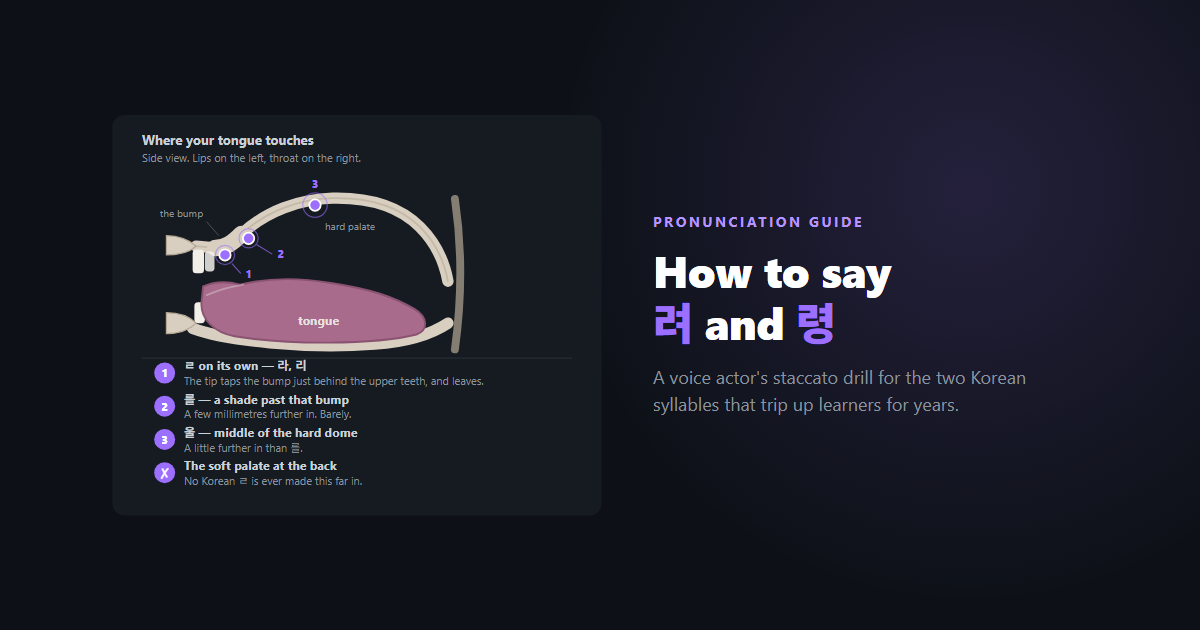
Do this now, with your tongue, not your eyes. Run the tip backward from your upper front teeth. You will pass three landmarks:
- a bumpy, hard ridge immediately behind the teeth
- the hard dome of the palate that rises behind it
- further in, where the roof turns soft
Every ㄹ you will ever make lives between that bumpy ridge and the middle of the hard dome. Nothing is made on the teeth themselves, and nothing goes as far in as the soft part.
- ㄹ on its own (라, 리) — the tip taps the bump right behind your upper teeth: the hard, raised spot you just found, not the back of the teeth. Lightly, and it leaves immediately. One tap. It does not sit there. It does not curl back the way an English R does.
- 를 — a shade past that bump. Barely. You are not hunting for a new place; you are sliding a few millimetres further in than a plain ㄹ.
- 울 — a little further in than 를, around the middle of the hard dome, and the tip presses the roof there. It moves toward the soft part but never reaches it. If your tongue feels like it is heading for your throat, you have gone too far.
Notice how small these distances are. The whole difference between a Korean ㄹ that sounds native and one that sounds foreign is a few millimetres and how long the tongue stays. If you want the wider version of this idea, I wrote about it here: The Physical Logic of Korean Pronunciation.
Everyone's mouth is shaped a little differently — the thickness of your tongue, the height of your palate. Feel around that ridge and find the spot where the sound comes out cleanest for you. There is no single millimetre that is correct for every person.
Your alphabet is working against you
A learner told me a story I have not been able to forget. They opened an account at 우리은행 and told their Korean colleagues, in English, "I opened an account at Woori bank." Nobody knew which bank they meant. Not one person.
They had said it exactly as the English letters instruct — a firm W, a rolling R. And that produced a word no Korean speaker recognised.
This is what romanization does to 려. The moment you read ryeo, your brain reaches for an English R, because that is what the letter means to you. English R is made by curling or bunching the tongue and holding it. Korean ㄹ is a single tap that leaves immediately. They are not variations of one sound. They are different movements.
So before anything else: stop reading ryeo. Look at 려. Listen to it. Copy the sound, not the spelling. Romanization is training wheels — useful for a week, and after that it is steering you into the wall. Hangul was designed so you would not need a crutch: King Sejong built the shapes out of the mouth positions themselves.
Why 려 is harder than 라
려 is ㄹ plus ㅕ. The ㅕ is not a plain vowel — it starts with a glide, a fast y that pulls the middle of your tongue up toward the roof of your mouth.
So in the space of one syllable your tongue has to: tap forward, then immediately hump upward. Two movements, opposite directions, no pause allowed.
What most learners do instead is choose one. You either land the tap and lose the glide — so 려 comes out as something close to 러 — or you commit to the glide and the tap disappears, and 려 turns into 요. If someone has told you your 려 sounds like 요, that is exactly what happened: the glide survived and the tap did not.
One method fixes both: staccato training
Do not try to say 려 or 령 as a single sound. Your tongue and your brain will lock, and repeating a locked movement only trains the lock.
This is an articulation drill used on professional voice actors to untangle exactly this kind of knot. It works because it never lets you attempt the hard movement at full speed — it walks you into it.
려 and 령 are the same problem — 령 is simply 려 with a ㅇ closing it — so one drill handles both.
Step 1 — break the syllable into two blocks.
| Sound | Block 1 | Block 2 |
|---|---|---|
| 려 | [리] | [여] |
| 령 | [리] | [영] |
Step 2 — say the two blocks apart, like staccato notes in music. A clear, short stop between them. Do not blur them yet. Do this until it is boring.
[리] … [영] [리] … [영] [리] … [영]
Step 3 — speed it up, a little at a time. Do not try to delete anything. Say the same two blocks slightly faster on each pass. The stop shrinks because you are moving faster, and so does the 이. At some tempo the 이 can no longer hold a beat of its own and collapses into the glide — and that is 령. Never jump straight to the end, and if the tap disappears as you accelerate, you have gone too fast: drop back a notch and climb again.
[리] … [영] ➡ [리 - 영] ➡ [리영] ➡ 령
And the same staircase for 려:
[리] … [여] ➡ [리 - 여] ➡ [리여] ➡ 려
Why the extra 이 is not cheating
The 이 you are adding in the middle is not a mistake. It is a handrail. It parks your tongue in the tap position with a high front vowel already in place — and that is exactly the shape the glide in ㅕ needs to launch from. You are not adding a sound. You are giving the movement somewhere to start.
Once you are quick enough, the 이 has no room left to be a syllable of its own, and it falls out. You never have to take it away deliberately, and trying to remove it early is how people get stuck again.
A learner who had been fighting 령 for a long time tried this and wrote back the same day: it took only a few attempts before the 이 dropped away and 령 came out whole. That is the normal outcome. This is not a months-long project. It is a movement your tongue has simply never been walked through.
If staccato does not do it: give the tap a running start
Some people can split the syllable perfectly and still not land the 려. The staccato drill fixes a sequencing problem — a tongue that stops between the two movements. This one fixes a mechanical problem: a tap you cannot make at all.
Say 울. Stop there, with your tongue still pressing the middle of the hard dome.
Now release it. Let the tip spring forward, toward your teeth, and let the ㅕ ride out while it is travelling.
울 ➡ 려
Slowly, ten times. Do not aim. Just let it go and let the vowel come out on the way.
Here is why this works, and it is the part nobody explains. A tap made from a standstill is genuinely hard. You have to touch and leave in a single motion, and most learners either press too hard and turn it into an L, or never commit and lose it entirely. But a tap made while the tongue is already moving happens by itself. Starting from 울 gives your tongue a run-up. You are no longer aiming at the spot — you are passing through it.
If one of these two drills does nothing for you, use the other. They repair different faults, and you only need the one that matches yours.
를 — the one that never stops coming
려 and 령 are sounds you can avoid. 를 is not. It marks the object of almost every sentence you will ever say, which means an awkward 를 is audible in your Korean about once every few seconds.
"I have a massive difficulty pronouncing 를 naturally" was the single most upvoted comment I received, and the replies underneath it were people saying anything ending in ㄹ defeats them — 를, 릴, 을, 말, 물.
Here is the part no textbook told you: 를 and ㄹ are not made in the same place.
- For ㄹ alone, the tip taps the bump right behind your upper teeth and leaves.
- For 를, the tongue sits further in — not pulled toward your throat, but back from that bump — and meets the roof of your mouth. If you make 를 up on your teeth, it comes out thin and English, and that is the "unnatural" quality you have been hearing in your own voice.
Try both back to back and feel the difference in where your tongue lands: 라 · 를 · 라 · 를. If they feel like they happen in the same place, they are wrong.
ㄹ at the end of a syllable
을, 말, 물, 갈. Here the vowel comes first and the tongue closes afterwards, and the order matters more than people expect.
Take 을. Make the 우 mouth shape first — lips rounded, tongue back. Then lift the tip to the roof of the mouth, just past that bumpy ridge, and stop. Do not add a vowel after it. Do not let the tongue slide forward to the teeth on the way. The sound ends with the tongue still touching.
English speakers have a specific trap here: the English "dark L" at the end of a word (full, call) pulls the back of the tongue down and produces a hollow, swallowed sound. Korean ㄹ does not do that. The back of the tongue stays where it was; only the tip moves.
Practise on real words, not drills
Say each one slowly in staccato blocks first, then run it again a little faster each time until it comes out whole.
| Word | Break it as | Meaning |
|---|---|---|
| 채령 | 채 · [리] · [영] | a name (ITZY) |
| 대령 | 대 · [리] · [영] | colonel |
| 유령 | 유 · [리] · [영] | a ghost |
| 요령 | 요 · [리] · [영] | the knack, know-how |
| 여려 | 여 · [리]…[여] | to be delicate |
| 배려 | 배 · [리]…[여] | consideration |
| 노력 | 노 · [리]…[역] | effort |
| 이름을 | 이 · 르 · 믈 | the name (object) |
| 물을 | 무 · 를 | the water (object) |
| 말할래 | 마 · 랄 · 래 | shall I say it? |
What to listen for
When it is right, the ㄹ is a single, light tap — closer to the d in American "ladder" than to any English R. There is no curl, no growl, and the tongue never stays anywhere.
When it is wrong, one of two things happened:
- It sounds like 요 — you skipped the tap and went straight to the glide. Go back to the staccato blocks and make the [리] half deliberately long and clear. That is the half you are dropping.
- It sounds like 러 or 렁 — you landed the tap but never lifted the middle of the tongue. Same blocks, but hold the [영] half instead. That is the half that is missing.
If it still will not come out
Two things, in this order.
Relax your mouth first. Sounds that do not exist in your native language make people tense, and a tense tongue is a stiff tongue. Before practising, stretch your lips wide and then round, move your jaw side to side, and do a lip trill — brrr. I do this before every script I read, in my own language. It is not a warm-up for beginners; it is what the work requires.
Then stop forcing the textbook position. If a spot is uncomfortable, or the sound leaks, move your tongue two or three millimetres forward, back, or higher, and keep adjusting until you find the place where your mouth produces it cleanly. The thickness of your tongue, the height of your palate, even the gap between your front teeth all change what is physically easy for you. When a position does not work, that is information about your anatomy — not evidence that you are bad at this.
Questions people ask me about this
How do you pronounce ㄹ in Korean?
ㄹ is a single tap of the tongue tip — not an R and not an L. At the start of a syllable (라, 리) the tip touches the bump right behind your upper teeth — not the back of the teeth — and leaves immediately. As a final consonant (을, 말, 물), make the 우 mouth shape first, then lift the tip a shade further in than that bump, and stop there. It never curls back the way an English R does, and at the start of a syllable it never lingers.
How do you pronounce 려?
려 is ㄹ plus ㅕ — a tap followed immediately by a y-glide, which is why your tongue stalls between them. Do not attempt it as one sound. Split it into [리] and [여], say them apart with a clear stop, then shorten the stop until they merge: [리] … [여] ➡ [리 - 여] ➡ [리여] ➡ 려. The 이 in the middle drops out on its own.
How do you pronounce 령?
령 is 려 with a ㅇ closing it — three movements in one syllable, which is why it defeats people for years. Split it into [리] and [영], say the two blocks apart like staccato notes in music, then say the same pair a little faster on every pass: [리] … [영] ➡ [리 - 영] ➡ [리영] ➡ 령. Most learners need only a handful of correct repetitions before the 이 falls away by itself.
Why does my 려 sound like 요?
You are skipping the tap and going straight to the glide, so only the ㅕ survives. Use the staccato drill and make the [리] half deliberately long — long enough to feel the tongue touch — until the tap reappears. Then shorten it again.
How do I pronounce 채령 (ITZY's Chaeryeong)?
채 · [리] · [영]. Say the three blocks apart, with clear stops, then shorten the stops until they merge. Do not try to say 채령 at speed until the blocks are automatic.
Is Korean ㄹ an R or an L?
Neither. It is a single tap of the tongue tip — closest to the d in the American pronunciation of "ladder". English R curls or bunches the tongue and holds it; Korean ㄹ touches and leaves immediately. Thinking of it as R or L is what makes it hard.
Why does my 를 sound unnatural?
Almost always because you are making it too far forward — on the teeth themselves, or right on the bump where a plain ㄹ lives. 를 sits a shade further in than that. Say 라 · 를 · 라 · 를 and feel the tongue land in two different places.
How long does this take to fix?
Shorter than you expect, if you drill it correctly. Learners who had carried this for years have reported the 이 dropping out after a handful of attempts. What takes time is not the movement — it is unlearning the habit of forcing the whole syllable at speed.
If you remember five things
- Korean ㄹ is one tap, not an R and not an L. It touches and leaves.
- The three places are all within a few millimetres: the bump behind the teeth (ㄹ), a shade past it (를), the middle of the hard dome (울). Nothing is made on the teeth, and nothing goes as far back as the soft palate.
- Do not attempt 려 or 령 whole. Split it, then accelerate — [리]…[여] and [리]…[영], a little faster every pass. The 이 falls out by itself once you are fast enough; you never remove it.
- If the tap will not come at all, start from 울 and spring forward. A tap made in motion is easier than a tap made from a standstill.
- Relax first, and adjust the position to your own mouth. A spot that does not work is information about your anatomy, not a verdict on your ability.
One last thing
Nearly everyone who wrote to me about 려 said some version of the same sentence: "I can say it, but it takes extra thought."
That gap — between being able to produce a sound and being able to produce it without thinking — is not closed by understanding. It is closed by repetition, in small correct movements, until the muscle stops needing you. Ten slow, correct 려 will take you further than a hundred fast, anxious ones.
Go slowly. The speed comes on its own.