잔을 채우다 (jan-eul chae-u-da): Why an Empty Glass Feels Like an Emergency in Korea
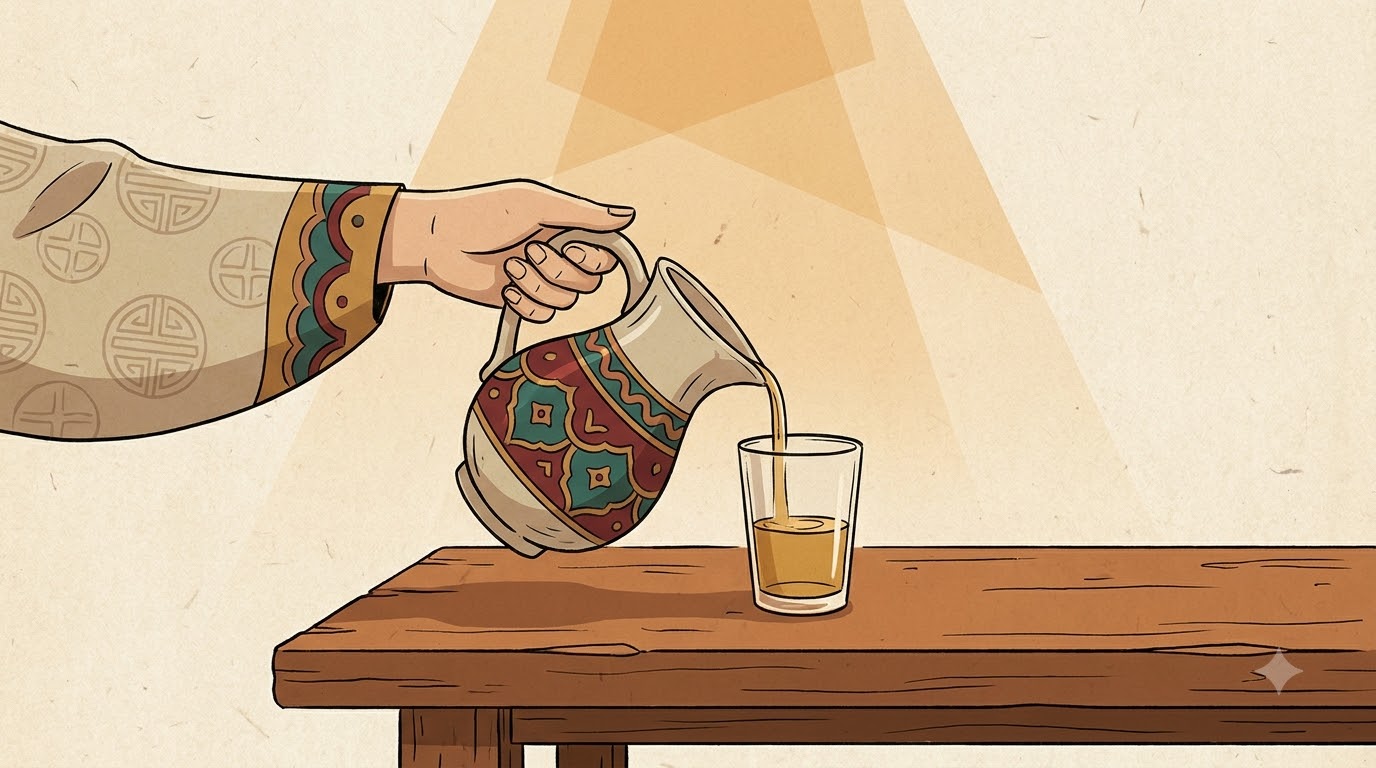
A common scene in any crowded Seoul dining establishment plays out with quiet precision. A newcomer sits down at a table shared with colleagues, taking small sips from a glass of beverage. Within seconds of the glass dropping below the halfway mark, a companion's hand reaches across with a bottle, topping it off before the drinker has even finished swallowing.
For an uninitiated foreigner, this can feel like an aggressive drinking contest or an unexpected invasion of personal autonomy. In many Western social settings, constantly hovering over someone's cup signals micromanagement, impatience for them to finish, or a subtle pressure to keep pace. Naturally, this constant attention can make newcomers tense, wondering if they are drinking too slowly or failing some unspoken test.
Yet in Korea, the refilling action operates on an entirely different relational frequency. Of course, human beings are wonderfully diverse, and not every single person adheres strictly to traditional dining customs. Still, as a widespread social tendency, an empty glass in Korean social logic is rarely treated as a neutral object. Instead, it is viewed as an accidental void of attention.
When a container sits empty, it signals to the table that the host or companion has momentarily stopped watching over the guest's comfort. By immediately replenishing the drink, the pourer communicates absolute, continuous presence. It transforms a simple act of beverage distribution into a physical punctuation mark that says I see you, I am taking care of you, and you are never alone at this table.
To understand this dynamic, one must look at how language and physical gestures intertwine in everyday life. When someone engages in this habit, they are performing the act of 잔을 채우다 (jan-eul chae-u-da, "to fill a glass"). Far from a mechanical beverage service, this action represents the primary physical currency of Korean hospitality. It maintains the unbroken flow of conversation and connection, acting as a non-verbal check-in on the guest's well-being.
The anxiety often arises because of what an empty cup implies in this cultural framework. When 잔이 비다 (jan-i bi-da, "for a glass to be empty") occurs, it represents a temporary lapse in attentiveness. In Korean table etiquette, an empty vessel is treated with gentle urgency because it symbolizes isolation or neglect. It must be mended instantly by anyone at the table who notices the gap.
Furthermore, the physical execution of this care matters just as much as the timing. The act of 따르다 (ttareu-da, "to pour a drink") carries strict relational weight. The physical habit of holding a bottle with two hands, or supporting the pouring arm with the opposite hand, reflects age hierarchy, respect, and the conscious bridging of distance between two people. Even when pouring for a younger peer where two-handed formality is relaxed, the movement remains deliberate and focused entirely on the recipient.
Once a learner decodes this hidden logic, the hovering bottle stops looking like an intrusion and starts looking like what it truly is: an extension of conversation. The liquid being poured is secondary to the message traveling through the air. It is a reminder that in Korean social spaces, companionship is an active, ongoing verb, measured not just in words spoken, but in the quiet attentiveness paid to the space right in front of you.
Warmth in these spaces isn't left to chance or assumed in the background; it is actively poured, glass by glass, keeping the connection as full as the cup on the table.
Quick Questions
Why do people keep filling my glass before it is empty in Korea?
In Korean social culture, a constantly refilled glass is a sign of continuous care and attentiveness rather than pressure to drink. While individual styles vary widely, a widespread tendency treats an empty cup as a sign of neglected comfort. Topping it off instantly communicates that your companions are actively looking after you and enjoying your company.
Is it considered rude to refuse a refill or leave my glass empty?
Refusing a refill entirely can sometimes disrupt the flow of hospitality, but learners can politely manage their pace by taking small sips so the glass stays partially full. If you genuinely cannot drink anymore, leaving the glass full and thanking the pourer with a polite nod is generally understood without causing offense.
🔊 Pronunciation Guide
Natural-sounding audio for the Korean in this article. Listen, then shadow out loud.
The exact phrases Koreans actually use every day — with the nuance notes that keep you from sounding like a textbook. Delivered as a beautiful PDF, free.
Send Me the Free PDFNo spam. Unsubscribe anytime.