우리 (u-ri): Why Do Koreans Say "Our Mom" Instead of "My Mom"?
If you are learning Korean, there is a moment early on when textbook logic completely breaks down in real life. You learn that "my" in Korean is 내 (nae, "my"). Naturally, when you want to talk about your mother, your husband, or your school, you try to say "my mom." But then a native speaker looks at you, slightly confused, and you hear someone casually refer to 엄마 (eom-ma, "mom") as 우리 엄마 (u-ri eom-ma, "our mom").
Wait. Our mom? Does this person share a mother with everyone in the room? Is there a giant communal family tree you missed out on?
Grammar textbooks often label this as a quirky exception or tell you to just memorize it as a vocabulary list. But it is not a random glitch in the language. It is your first real window into how Korean grammar maps a completely different way of seeing the self.
- • The Logic of the Collective Self
- • Mapping Out the "Uri" Zones
- • 1. Family and Close Relationships
- • 2. Institutions and Belonging
- • 3. The Ultimate Collective: Country
- • When Do You Actually Say "My"?
- • A Practical Shortcut to Apply Today
- • Quick Questions
- • Why do Koreans say "our mom" (우리 엄마) instead of "my mom"?
- • When should I use 내 (nae) instead of 우리 (u-ri)?
The Logic of the Collective Self
To understand why this happens, we have to look past simple translation. In English and many other global languages, the individual is the starting point of the universe. The self is an independent unit. You say "my car," "my house," and "my friend" because those things belong to you, the sovereign individual. "I" comes first, and the relationship comes second.
In Korean culture, the baseline social reality is structured quite differently. Broadly speaking, Korean society places a deep cultural value on 집단주의 (jip-dan-ju-ui, "Collectivism — the cultural value prioritizing group identity over individual identity")—though, of course, real life involves plenty of diverse individuals with their own unique styles and personal boundaries, rather than a monolithic hive mind. Still, this foundational cultural pattern deeply shapes the language.
In this framework, the self is rarely viewed in absolute isolation. Instead, an individual is understood as part of a wider web of relationships. "I" am not just an isolated floating dot; "I" am a son or daughter, a team member, a citizen, and a friend. Because of this, the language often reaches for a word that expands the boundary of the individual to include the group.
This is where 우리 (u-ri, "We / Our — used as a collective possessive in Korean, even for personal relationships") steps in. The core nuance here is that u-ri assigns a collective nature even to personal belongings and close relations. This is perhaps the most direct linguistic reflection of Korea's collectivist and jeong culture. By using u-ri, you are linguistically pulling the person, place, or object into your shared sphere of warmth and responsibility.
Mapping Out the "Uri" Zones
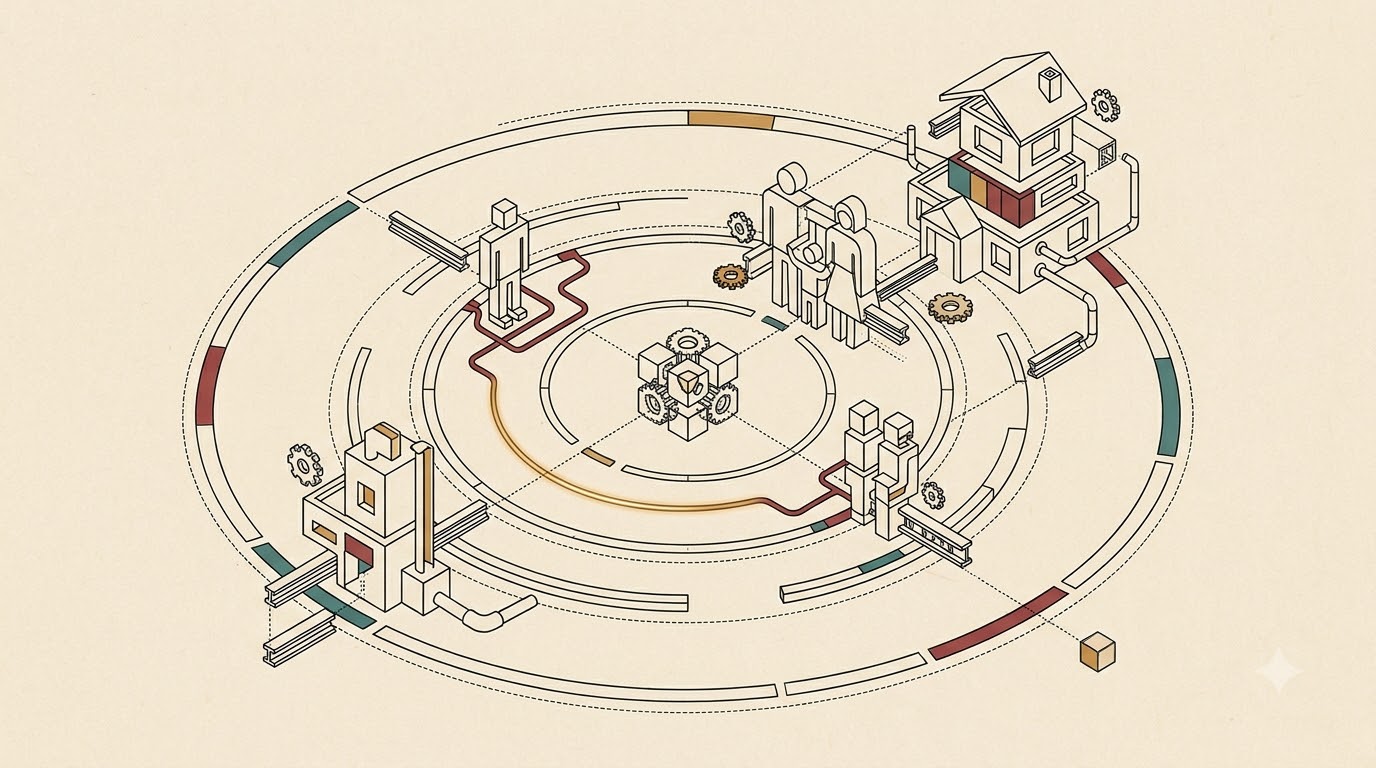
Once you start looking for it, you will notice u-ri everywhere. But native speakers do not use it randomly for everything they own. There is a precise, invisible map governing when to use u-ri and when to use 내 (nae, "my"). Let's break down the three main territories where u-ri reigns supreme.
1. Family and Close Relationships
When speaking to strangers, acquaintances, or even close friends, Koreans almost always use u-ri for family members: * 우리 엄마 (u-ri eom-ma, "my mom") * 우리 아빠 (u-ri a-ppa, "my dad") * 우리 남편 (u-ri nam-pyeon, "my husband") * 우리 아내 (u-ri a-nae, "my wife") * 우리 오빠 (u-ri o-ppa, "my older brother, female speaker")
If you introduce your husband to a new colleague and say 내 남편 (nae nam-pyeon, "my husband"), native speakers won't correct you, but it might sound a bit jarring—almost like a contract or a piece of property rather than a shared life partner. Using u-ri softens the boundary and signals warmth.
2. Institutions and Belonging
Institutions that you belong to are also wrapped in this collective embrace. This connects deeply to 소속감 (so-sok-gam, "Sense of belonging — the feeling of being part of a group"). For Koreans, a sense of belonging is directly reflected in the language, where using u-ri is an expression of feeling emotionally invested in that collective unit: * 우리 학교 (u-ri hak-gyo, "my school") * 우리 회사 (u-ri hoe-sa, "my company") * 우리 팀 (u-ri tim, "my team") * 우리 반 (u-ri ban, "my class")
When an employee complains that 우리 회사가 너무 바빠요 (u-ri hoe-sa-ga neo-mu ba-ppa-yo, "our company is so busy"), they aren't just stating a corporate fact. They are expressing a shared, collective grievance about a place they belong to.
3. The Ultimate Collective: Country
Perhaps the most powerful example of this linguistic habit is how Koreans talk about their nation. Instead of calling South Korea by its formal name in casual daily life, people almost universally say: * 우리나라 (u-ri na-ra, "Our country (= Korea, when said by Koreans)")
This is an expression of strong collective identity. It treats the entire nation as an extended family home. Interestingly, if a foreign learner who has built a deep connection with Korea naturally says u-ri-na-ra, native speakers often feel a wave of genuine delight because it signals that the learner has stepped inside the cultural circle.
When Do You Actually Say "My"?
If u-ri is so popular, does 내 (nae, "my") ever get used? Absolutely. If you used u-ri for everything, the language would lose its precision.
You drop u-ri and switch to 내 (nae) in three specific situations: * Personal opinions and inner feelings: When expressing something uniquely yours that others might not share, use 내. For example: 내 생각엔... (nae saeng-gak-en, "in my opinion...") or 내 느낌은... (nae neu-gkim-eun, "my feeling is..."). * Individual possessions: Objects that you bought for yourself or received as private gifts take nae. Think of 내 핸드폰 (nae haen-deu-pon, "my cell phone") or 내 노트북 (nae not-buk, "my laptop"). You do not share your smartphone with your entire office team (hopefully!), so it remains strictly individual. * Contrast or emphasis: If you want to draw a sharp line between your view and someone else's, nae cuts through the collective fog: 내 의견은 달라 (nae ui-gyeon-eun dal-la, "My opinion is different").
If you use nae with family—such as saying 내 엄마가 최고야 (nae eom-ma-ga choe-go-ya, "My mom is the best")—it isn't grammatically wrong, but in front of a group, it can sound slightly self-centered or socially detached, as if you are fencing off your mother from the rest of the world.
A Practical Shortcut to Apply Today
Here is how you can use this linguistic logic to sound instantly more natural in your next Korean conversation.
Stop translating word-for-word from your native language. Instead, run a quick mental checklist before you speak: 1. Is it a person, group, or place that defines a part of your social identity? (Family, school, company, country, close crew) 👉 Use 우리 (u-ri). 2. Is it an individual gadget, a personal physical item, or a strictly private thought? 👉 Use 내 (nae).
By shifting from "my" to "our" for your close circles, you stop sounding like an outsider translating a textbook and start sounding like someone who understands the heartbeat behind the words.

Quick Questions
Why do Koreans say "our mom" (우리 엄마) instead of "my mom"?
In Korean culture, the individual is understood through a network of relationships rather than in total isolation. Using 우리 (u-ri, "We / Our — used as a collective possessive in Korean, even for personal relationships") pulls family members and close circles into a shared sphere of warmth and belonging. Saying "my mom" can sometimes sound socially detached, whereas "our mom" reflects a deeply relational view of the self.
When should I use 내 (nae) instead of 우리 (u-ri)?
You should use 내 (nae, "my") for strictly personal possessions that you do not share with a group—such as your smartphone, laptop, or private diary—as well as for purely individual thoughts and opinions. If you want to emphasize a personal view that differs from everyone else's, switching to 내 (nae) cuts through the collective language and highlights your distinct stance.
🔊 Pronunciation Guide
Natural-sounding audio for the Korean in this article. Listen, then shadow out loud.
The exact phrases Koreans actually use every day — with the nuance notes that keep you from sounding like a textbook. Delivered as a beautiful PDF, free.
Send Me the Free PDFNo spam. Unsubscribe anytime.