체면 (Che-myeon): Why Your First "No" at a Korean Dinner Table is Just a Door-Handle, Not a Wall
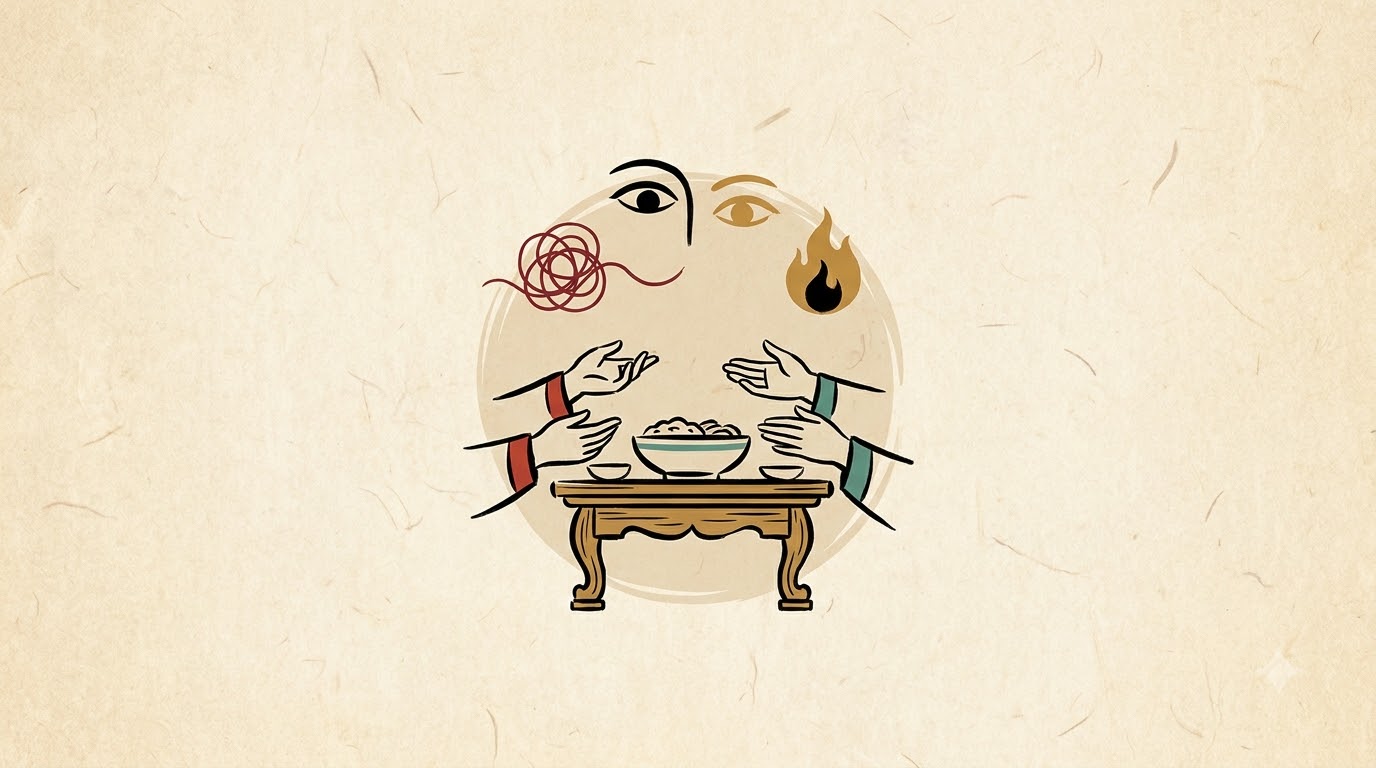
Imagine sitting down at a bustling company dinner or a traditional home-cooked meal in Seoul. The host cheerfully slides a brimming plate of galbi toward you and insists you eat more. Eager to be polite, honest, and clear, you smile and say, "No thank you, I'm full."
In English-speaking cultures, that is the final curtain. A clear "No" respects autonomy, ends the negotiation, and allows everyone to move on. But in Korea, your host might look slightly startled, pause for a second, and then cheerfully scoop even more food onto your plate anyway.
You find yourself trapped in a frustrating loop. Why did they ignore your polite boundary? Are they just being pushy?
As it turns out, you haven't made a vocabulary error—you’ve run into a cultural misunderstanding of linguistic rhythm. In Korean conversation, the first refusal is not a final shutdown; it’s an invitation to a carefully choreographed social dance. While individual comfort levels naturally vary across every culture and not every single person behaves the exact same way, understanding the logic behind this interaction can transform your next meal from an awkward guessing game into a warm cultural exchange.
The Tripartite Rhythm of Refusal and Re-offer
To understand why a simple "no" doesn't quite work the way you expect, we have to look at the structural mechanics of Korean hospitality. It operates on a three-beat rhythm designed to balance comfort, generosity, and public dignity.
At the heart of this system lies 체면 (che-myeon), which translates to social face, public standing, and the invisible boundary of mutual dignity. Che-myeon is far deeper than mere pride. It is the social glue that keeps interpersonal friction low by ensuring neither party loses dignity in public or private interactions. Maintaining face means protecting both your own standing and the other person's comfort.
When someone offers you food or hospitality, accepting it instantly without any hesitation can make you look unmindful of your 염치 (yeom-chi). Yeom-chi refers to a sense of shame, propriety, and basic decency regarding unearned favors. Having yeom-chi means being acutely aware when you are receiving more than you give back. In Korean social life, showing too little hesitation when someone offers food or help can make you look shameless.
To protect both parties' che-myeon and demonstrate proper yeom-chi, the conversation flows through three distinct steps:
- The First Deferral: When the host offers food, you gently push back to minimize burden.
- The Second Urging: The host warmly insists, signaling genuine hospitality.
- The Acceptance: You graciously accept, showing appreciation without looking greedy.
Let's look at how this plays out in real life through the language itself.
Decoding the Three Table Scenes
Let's break down the exact phrases you will encounter and the linguistic logic behind them. When a host urges you to eat more, your instinctive reaction shouldn't be a cold wall, but a polite deferral using 사양하다 (sa-yang-ha-da).
To 사양하다 means to decline politely, to defer out of modesty or consideration. Unlike a blunt refusal, it carries a warm undercurrent of appreciation. You are declining not because you dislike the offer, but because you care about not burdening the host—making it a ritualistic dance rather than a barrier.
Here is how the standard table scenes unfold:
- Scene 1: The First Refusal
- 한국어: 아닙니다, 정말 배부릅니다. (a-nim-ni-da, jeong-mal bae-bu-reum-ni-da, "No, I am truly full.")
-
The Nuance: This is not a terminal signal. It is your first defensive line, thanking them for their goodwill while trying not to impose. If the host takes this literally and whisks the food away, they might actually feel a bit disappointed that you didn't give them a chance to show true hospitality.
-
Scene 2: The Second Offer and Acceptance
- 한국어: 그럼 조금만 주십시오. (geureom jogumman jusipsio, "Then please give me just a little bit.")
-
The Nuance: This is the most polite timing to accept after the first refusal, when the host insists a second time.
-
Scene 3: Cushioning a Drink Offer
- 한국어: 술을 잘 못 해서요. (su-reul jal mot hae-seo-yo, "I can't drink well.")
- The Nuance: In a drinking setting, this acts as a soft social cushion. It refuses the alcohol while gently informing them of your limit without killing the mood.
When a host 권유하다 (gwon-yu-ha-da)—meaning to recommend or urge warmly with hospitality—they are doing something deeper than simply passing a dish. Gwon-yu-ha-da is more than a suggestion; it is an active push rooted in care. When a host gwon-yuhanda, they are investing their own warmth into your well-being, expecting a polite back-and-forth rather than immediate obedience.
The Grammar of Soft Deferral
If you want to sound natural while navigating these moments, your choice of grammatical ending matters immensely. Western languages often rely on directness, but Korean relies on softening agents.
Consider the difference between these two approaches:
- 한국어: 배불러서요 (baebulleoseoyo, "Because I'm full...") — Leaves the sentence trailing open softly, inviting a warm response.
- 한국어: 안 먹습니다 (an meokseumnida, "I do not eat.") — Too rigid, clinical, and can sound surprisingly hostile in a casual dining context.
By ending your sentence with an explanatory connector like -서요 (-seoyo), you provide a reason while leaving the conversational door unlocked.
Of course, reading these social cues requires rapid situational awareness. This is where 눈치 (noon-chi) comes into play. Noon-chi is your rapid situational radar and the ability to read the unspoken emotional current. It is the invisible gauge that tells you whether the host's second offer of food is genuine hospitality or a polite formality. Without noonchi, you might accidentally eat food you hate or refuse food you secretly crave.
A Practical Guide to Applying This Today
You don't need to master complex social hierarchies overnight to use this rhythm to your advantage. Try applying this simple two-step framework during your next meal with Korean friends or colleagues:
- Soften the initial "No": Instead of a sharp, definitive English-style refusal, add a softening phrase that acknowledges their effort. Use expressions like 배불러서요 (baebulleoseoyo, "I'm quite full, but...") or 마음만 받을게요 (maeumman badeulgeyo, "I'll take your kind heart [as the food]").
- Watch for the second beat: When they insist a second time—which they likely will in many traditional settings—do not panic or stubbornly refuse a third time. Smile, nod, and accept a small portion. It signals that you value the relationship more than rigid adherence to your personal calorie count for that single meal.
The golden rule to remember: Your first refusal at a Korean table is a door-handle, not a wall. Pull it gently, wait for your host to turn it from the other side, and step through into a warmer, more connected dining experience.
Take a deep breath, enjoy the food, and remember that every culture has its own beautiful choreography of care. You've got this!
Quick Questions
- Why do Koreans keep offering food after you say no? In Korean dining culture, the first refusal is interpreted as a polite gesture of modesty rather than a strict command to stop. Hosts often expect a brief back-and-forth rhythm where they urge you once more to ensure you feel genuinely welcomed and comfortable accepting.
- How do I politely decline food in Korean without being rude? Instead of using a blunt, definitive statement like 'No', use a soft explanatory ending such as 배불러서요 (baebulleoseoyo, "Because I'm full"). This cushions your refusal by showing appreciation for the host's effort while politely stepping back from taking more food.
🔊 Pronunciation Guide
Natural-sounding audio for the Korean in this article. Listen, then shadow out loud.
The exact phrases Koreans actually use every day — with the nuance notes that keep you from sounding like a textbook. Delivered as a beautiful PDF, free.
Send Me the Free PDFNo spam. Unsubscribe anytime.